
Columbus Warrant Checks
Match the office to the event. That beats any generic name-search site. Columbus Police may hold investigative or warrant documents, Municipal and Magistrate Courts handle warrant applications, and Recorder's Court controls traffic citations and failures to appear. Superior and State Court keep their own criminal dockets. Because Columbus and Muscogee County run as a consolidated government, city and county labels overlap, and each record custodian still plays a different role. A Columbus warrant check, in short, means knowing which desk holds the file.
- Use the official court portal for a likely Superior or State Court case and Recorder’s Tyler portal for a traffic citation.
- Call Municipal Court at (706) 653-4378 or Magistrate Court at (706) 653-4790; official sources conflict on the latter number, so verify it.
- Ask CPD Central Reports about an existing police document or submit a narrow open-records request.
- Call MCSO at (706) 653-4225 about a sheriff-held or served warrant and the issuing-court route.
- Consult counsel before an in-person check if custody is possible; Georgia offers no verified public statewide warrant search.
Columbus’s City-County Naming Trap
Columbus wears two hats in Muscogee County. It is the county seat, and official Census place data lists it as the only incorporated place there. The 2020 Census counted 206,922 residents. A July 1, 2025 QuickFacts estimate put the figure at 202,171. Consolidation is why a "Columbus warrant" search can land on a Muscogee Courts page, or why a county agency shares the Columbus government domain. It does not pour every record into one database.
Figure out which office holds the answer first. Columbus splits the work across CPD, MCSO, Superior Court, State Court, Magistrate Court, Municipal Court, Recorder’s Court, Juvenile Court, and Probate Court. Each one answers a different, narrower question.
Policing and Courts in Columbus
Columbus Police makes the arrests, and its Central Reports Unit keeps the reports, warrants, and related paperwork. MCSO processes incoming criminal warrants, handles jail and bond questions, and joins in service and fugitive work. The courts, not CPD or any public website, issue warrants in Columbus and decide whether appearance, bond, payment, or recall is on the table. So route your warrant check to the issuing court.
Columbus Police Department
Public Safety Building, 510 10th Street
Columbus, GA 31901
(706) 225-3205
Municipal Court Clerk
Government Center, eighth floor
100 10th Street, Columbus, GA 31901
(706) 653-4378
Columbus Government Center by Floor
The Columbus Government Center at 100 10th Street is a routing hub, not a single warrant counter. Superior and State Court Clerk services sit in the second-floor tower. The Sheriff’s public office is on the fourth floor, Probate Court on the sixth, and the Municipal and Magistrate warrant-related offices on the eighth. Recorder’s Court works separately at 702 10th Street. Show up on the wrong floor and you may land in an office with no power over the issuing court’s warrant. Each court keeps its own records, so the trip only pays off when you aim right.
| Second floor | Superior and State Court case records and criminal-division directions. |
|---|---|
| Fourth floor | Sheriff questions about processing, service, jail, and the proper unit. |
| Sixth floor | Probate proceedings, including a noncriminal evaluation-order process. |
| Eighth floor | Municipal and Magistrate warrant applications and court questions. |
| 702 10th Street | Recorder’s Court citations, traffic FTA, appearances, and eligible payments. |
Warrants in Columbus: The Main Types
In Columbus, one word covers a lot of ground. A warrant can be criminal or noncriminal, so confirm the document title, the issuing court, and the underlying case before assuming anything. A traffic failure to appear may run through Recorder’s Court and DDS, while a felony arrest warrant points elsewhere and may bring MCSO or CPD to serve it.
| Type | How It Arises | Columbus Route |
|---|---|---|
| Traffic FTA warrant | A required Recorder’s Court setting is missed. | Recorder’s Court |
| Bench warrant | A person misses court or fails to comply with an order. | The court handling the case |
| Arrest warrant | Probable cause is established through sworn information or judicial knowledge. | Superior, State, Magistrate, or authorized local judge |
| Search warrant | Investigators obtain authority to conduct a search. | Issuing judge; access is limited before execution or return |
| Warrant application | A complainant begins the judicial application process. | Municipal or Magistrate Court |
Columbus Traffic FTA Has Two Layers
Recorder’s Court handles Columbus traffic citations, ordinance matters, and the missed appearances that follow. Its online portal takes a citation or case number, a name with date of birth, driver-license details, vehicle information, or a few other defined combinations. A portal entry can help you find the case, but it does not promise the warrant field is complete or current. Skipping court can trigger a warrant or contempt consequence plus a separate DDS license action. Payment is not allowed in every case, and local sources describe the cutoff differently: 72 hours before court in one place, before 8:00 a.m. the day before court in another. Call (706) 653-4256 to confirm whether you must appear, whether payment is accepted, and what release goes to DDS.
Keep proof: retain the court receipt or recall document, then verify both warrant status and any separate DDS reinstatement step.
Columbus Warrant Records: What They Show
A solid Columbus warrant record matches the right person to the right court. Results can omit a field, and the status shown may lag a later return or recall. Treat what you find as a way to frame precise questions for the clerk, not as a final legal determination.
| Warrant / Cause Number | The issuing office’s identifier, illustrated as court record number; no universal public format was verified. |
|---|---|
| Subject Name | The legal name on the matter, checked with an approved secondary identifier to avoid a mistaken match. |
| Charge / Offense | The allegation or court obligation, which is not proof of guilt. |
| Issuing Court | The court controlling appearance, bond, payment, or recall. |
| Bond / Fine | A case-specific figure that may be absent or subject to judge review. |
| Status | Active, served, returned, recalled, or another term that should be confirmed as of the inquiry date. |
Columbus Police Records Are a Document Route
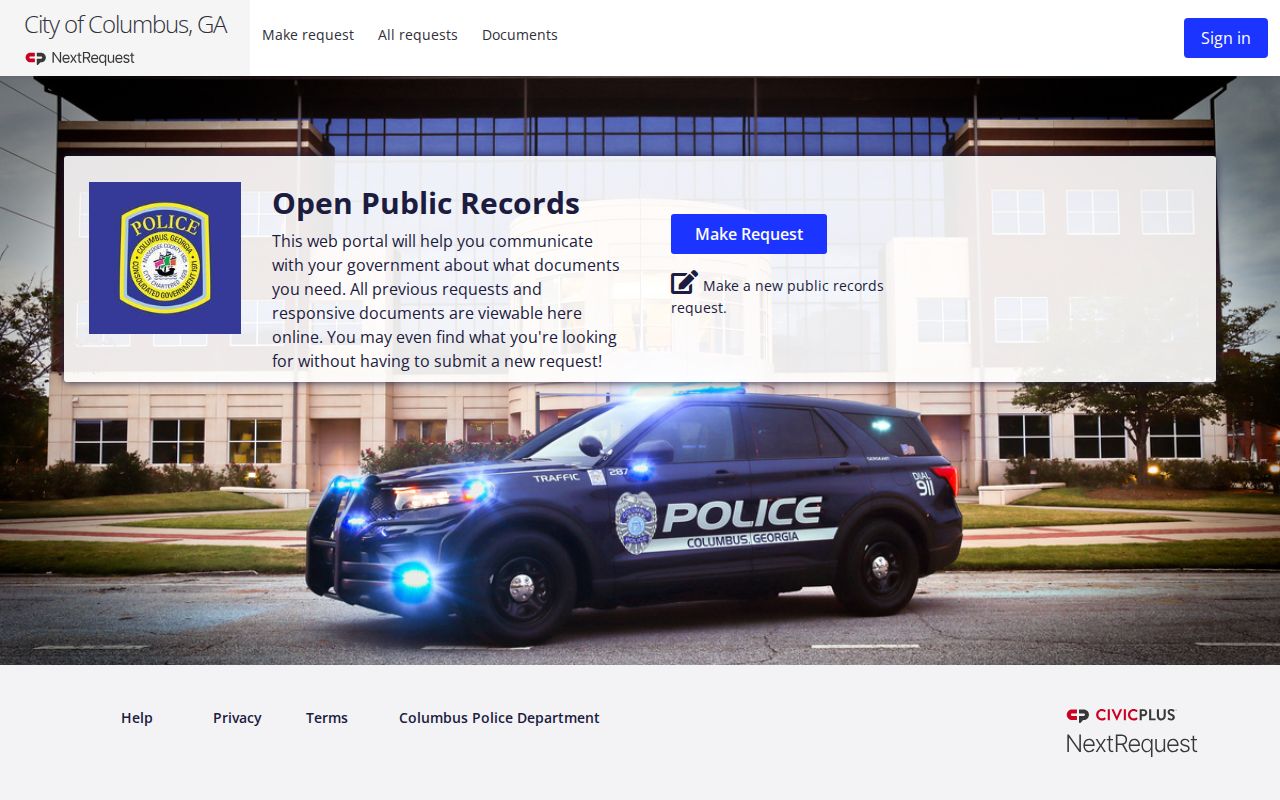
CPD Central Reports is worth a call because Columbus police say the unit maintains warrants among its other documents. A request can go through NextRequest, email at cpdopenrecords@columbusga.org, mail, fax, or a walk-in, and the published records line is (706) 225-4306. Treat it as a records channel. Nobody at that desk runs an instant name search of every active warrant for you. To get a useful answer, describe the record you want, name the agency or court involved, give a tight date range, and say whether you are asking about issuance, service, return, or recall. Request electronic files and a cost estimate. Georgia law lets CPD redact or withhold records under a specific exemption, and the unit may send you to a Columbus court or MCSO when that office holds the file. The official CPD request portal shows the police-side submission route.
Do not submit unnecessary personal identifiers through a public request form.
Columbus Warrants and Muscogee County
Columbus runs on local channels, not a statewide warrant database. A judge in Columbus signs a warrant after police investigate. The Muscogee County Sheriff may then serve it, though the issuing court keeps control of what happens next. Only that court can recall or quash the warrant. Georgia DDS enters the picture solely for license suspensions tied to certain traffic failures to appear.
Warrant flow: Columbus court / CPD › Muscogee County Sheriff › issuing-court and state administrative updates
Need the broader map of who holds what? The Muscogee County warrant records overview sorts every office by role. Columbus handles city matters only. Federal cases run through the U.S. District Court for the Middle District of Georgia, not any Columbus warrant portal.
Columbus Orders That Are Not Criminal Warrants
Paperwork that sounds like a warrant is not always one. Columbus Municipal Court applies warrant-style language to dispossessory, bad-check, abandonment, and distress matters, and only some of those put a person under a criminal arrest warrant. Probate Court adds its own wrinkle. The "Order to Apprehend and Transport" there is a civil step for a mental-health evaluation of someone age 17 or older, not a criminal warrant, and it guarantees no treatment. Juvenile Court files sit behind stricter confidentiality rules. The clerk offers affidavit and arrest-warrant forms, yet an adult-case portal or a phone request will not open a juvenile record; a party may have to appear with current photo identification. Columbus sources even disagree on the Juvenile Court floor, so call (706) 225-4290 before making the trip.
Accessing Columbus Warrant Records
Two rulebooks govern Columbus warrant records. The Georgia Open Records Act opens existing agency files, while court and confidentiality rules still shield particular judicial records. A request cannot force CPD or MCSO to build a citywide warrant list. Sealed cases, juvenile files, active investigative material, protected identifying details, and an unexecuted search warrant may come back withheld or redacted.
Key Rules:
Georgia Open Records Act, O.C.G.A. §§ 50-18-70 through 50-18-77 — existing public agency records are generally accessible unless a specific exemption applies.
Georgia Attorney General guidance — written requests create a clearer record even though requests may also be oral.
O.C.G.A. § 17-5-24 — an unexecuted search warrant and its supporting documents remain outside public inspection until execution or return not executed.
Columbus Roundups Are Enforcement Events
Columbus Police releases describe coordinated warrant sweeps, including a November 2025 roundup and later Fugitive Unit work. Those numbers count arrests made during a set operation. They are not a live tally of every Columbus warrant. CPD, MCSO, U.S. Marshals personnel, and other partners often join in, so a service record may rest with a different custodian than the original court docket. Columbus runs no standing warrant-amnesty or safe-surrender program. A roundup announcement, then, offers no special resolution terms. Anyone working on an outstanding warrant should contact the issuing court or a lawyer about appearance, bond, surrender, and recall. Operation totals answer nothing about a case.
Plan a Columbus Courthouse Visit
Georgia's own guidance is blunt: walking into a courthouse on a warrant inquiry can end in custody on the spot. Call the issuing court or MCSO first. Bring in a Georgia attorney when an active warrant, surrender, or bond could be in play. Before you go, confirm the office, floor, hours, identification rule, and security screening. The Sheriff advertises 24/7 assistance, though court counters keep their own schedule. The Government Center sits downtown near METRA routes and listed public parking; Recorder's Court operates separately at 702 10th Street. Transit tips ease the trip, but they confirm no warrant and promise no safe-surrender process. Carry a case or citation number if you have one. Give only the identifiers the office asks for. Keep written proof of any payment, bond, release, or recall.